
Our story
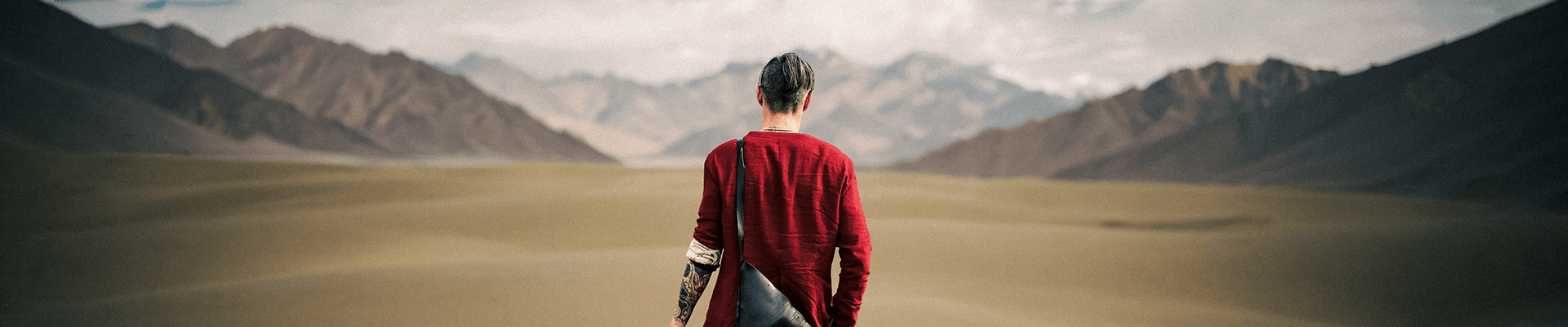
Textile Atlas on the move
VesteMMundi was born from an artistic and anthropological research project founded by Roberto “Joe” Scappaticcio. Through travel, clothing is explored as a narrative body: it crosses communities and landscapes, absorbing stories, tensions, and transformations. It is not a surface, but a threshold. It is not ornament, but language. The project intertwines sartorial design, documentary cinema, and the study of social contexts, taking the form of an independent laboratory in constant evolution: a space for research where creative practice becomes a tool for cultural investigation and aesthetics is rooted in ethics. VesteMMundi removes clothing from consumption and returns it to time.
Slow, authentic production
Each garment is the result of extensive listening and immersion in the territories traversed. There is no creation without relationship. The garments are designed by the author, who follows the development of the models and prototyping in direct dialogue with local artisans and communities. The fibers used are natural and sourced locally, chosen with respect for the material and the context. The material is not forced: it is understood.
The rhythm is not that of the market, but that of relationships.
Each creation is inseparable from the human context that makes it possible and carries with it the concrete trace of the encounter: a shared gesture, a story heard, a memory transmitted.
The rhythm is not that of the market, but that of relationships.
Each creation is inseparable from the human context that makes it possible and carries with it the concrete trace of the encounter: a shared gesture, a story heard, a memory transmitted.
In the Sierra Nevada, the village weaver of the Kogui community shows me his work on a vertical wooden loom.
Fiber becomes thought. Gesture becomes vision.
Fiber becomes thought. Gesture becomes vision.
On the plateau of Kharnak, the nomads of wool weave on their looms while wearing garments created in Colombia.
The relay of garments crosses continents: a single piece becomes a bridge between distant worlds.
The relay of garments crosses continents: a single piece becomes a bridge between distant worlds.
Method and ethical vision
Clothing becomes a mobile archive. It collects collective memories, cultural layers, and contemporary tensions. It preserves what is in danger of disappearing. The research is based on direct encounters with women's cooperatives, artisans, NGOs, and local communities, favoring short supply chains and ethical processes. It is not a question of aestheticizing tradition, but of recognizing it as living knowledge.
VesteMMundi promotes an examination of conscience on the contemporary fashion system: it values abandoned crafts, supports training courses, protects traditional knowledge, and promotes local production that respects people. The project invites us to abandon the logic of rapid consumption and return to conscious use, durability, and shared responsibility.
Each stage is not a simple geographical shift but a relationship.
The garment takes shape together with the people who make it possible, dialoguing with the history and identity of the territory.
VesteMMundi promotes an examination of conscience on the contemporary fashion system: it values abandoned crafts, supports training courses, protects traditional knowledge, and promotes local production that respects people. The project invites us to abandon the logic of rapid consumption and return to conscious use, durability, and shared responsibility.
Each stage is not a simple geographical shift but a relationship.
The garment takes shape together with the people who make it possible, dialoguing with the history and identity of the territory.
Continuity and Transmission
Clothes travel. They meet. They transform. Each stage dialogues with the previous one: creation becomes a bridge between communities, shared memory, and lived experience. Nothing is interrupted; everything is transmitted.
The documentaries accompanying the project follow events in a spontaneous and free manner, without scripts or forced repetitions. The authenticity of the situations is preserved. Filming and direction are handled by the author, maintaining a direct and immersive perspective.
The documentaries accompanying the project follow events in a spontaneous and free manner, without scripts or forced repetitions. The authenticity of the situations is preserved. Filming and direction are handled by the author, maintaining a direct and immersive perspective.
In the camp of Makhmour, a women’s cooperative keeps alive the tradition of Rojava garments, working in a tailoring workshop devoted to traditional dress.
To sew is memory. To sew is resistance.
To sew is memory. To sew is resistance.
At the foot of K2, in the village of Turtuk, we meet the Baltistan community.
The fabric preserves what history attempts to divide.
The fabric preserves what history attempts to divide.
The Chapters
Reunion — The island during silence
During the pandemic and global commercial shutdown, the scarcity of raw materials has forced a radical transformation of the creative process. Only cotton/linen furnishings and Malagasy fabrics are available, but the intense colors reconnect us to the natural power of the island.
Limitation becomes origin.
Subtraction generates vision.
The garments created are the first step in the relay: in Colombia, they will be worn by indigenous communities, inaugurating the continuity of the garment's journey.
During the pandemic and global commercial shutdown, the scarcity of raw materials has forced a radical transformation of the creative process. Only cotton/linen furnishings and Malagasy fabrics are available, but the intense colors reconnect us to the natural power of the island.
Limitation becomes origin.
Subtraction generates vision.
The garments created are the first step in the relay: in Colombia, they will be worn by indigenous communities, inaugurating the continuity of the garment's journey.
Amazon — Indigenous communities of Colombia
The natural fabrics are woven by hand by artisans from A New Cross, led by Nicolas Riveiro, using alpaca wool, cotton typical of the Amazon, and natural dyes. The dress becomes a meeting point and cultural exchange between the Andes and the Amazon, generating a dialogue between distant geographies, memories, and traditions.
The garments made in Reunion are worn here by the Murui, Kogui, and Totoyes communities. Local production opens new chapters: a dialogue between materials and ancestral knowledge, between ocean and forest.
The garments made in Reunion are worn here by the Murui, Kogui, and Totoyes communities. Local production opens new chapters: a dialogue between materials and ancestral knowledge, between ocean and forest.
Between the Indian Ocean and the volcano Piton de la Fournaise, on Réunion Island, nature observes the global silence of the COVID-19 pandemic.
Matter breathes.
(Opening of the medium-length film “Reunion Island” – 2020)
Matter breathes.
(Opening of the medium-length film “Reunion Island” – 2020)
Verde Sangue
A cinematic work where earth, root and matter confront one another.
Fashion sheds aesthetics to return to its origin.
A cinematic work where earth, root and matter confront one another.
Fashion sheds aesthetics to return to its origin.
Himalaya — Ethics and integrated supply chain
In the Himalayas, the collaboration with Jigmat Couture guarantees high-quality fabrics made from yak and linen fibers, natural dyes, and rigorous artisanal processes within a short and sustainable supply chain. Jigmat Couture is recognized for its attention to social responsibility, particularly towards women artisans, reconciling tradition, aesthetics, and ethical awareness.
Here, the project comes into contact with the rural communities of the Himalayan range: Dardi, Balti, and wool nomads. This is the context in which the film Parivara – Le Ultime Famiglie (Parivara – The Last Families) was created, exploring the textile families of the Himalayas, from Kashmir to Rajasthan, questioning the continuity of knowledge and the fragility of traditions.
The clothes made in Colombia are worn by Himalayan communities, completing the relay and becoming bearers of new stories, new gestures, and new memories.
Here, the project comes into contact with the rural communities of the Himalayan range: Dardi, Balti, and wool nomads. This is the context in which the film Parivara – Le Ultime Famiglie (Parivara – The Last Families) was created, exploring the textile families of the Himalayas, from Kashmir to Rajasthan, questioning the continuity of knowledge and the fragility of traditions.
The clothes made in Colombia are worn by Himalayan communities, completing the relay and becoming bearers of new stories, new gestures, and new memories.
Iraq — Identity and Resilience
In Iraqi Kurdistan, the project encounters Yazidi communities that survived ISIS persecution and women's cooperatives in the Makhmur camp. Until 2019, wearing traditional clothing could cost you your life here. In this context, clothing takes on a radical meaning. It becomes a political act, a symbol of peace, resilience, and cultural identity.
Himalayan clothes are worn by Yazidi, Assyrian, and Kurdish Muslim communities. At the same time, new garments are being made in Shal, a fabric rooted in Iraqi textile tradition, reaffirming a cultural continuity that violence had attempted to break.
The documentary resulting from this experience is currently being edited, ready to convey the stories, gestures, and memories of the communities involved.
Himalayan clothes are worn by Yazidi, Assyrian, and Kurdish Muslim communities. At the same time, new garments are being made in Shal, a fabric rooted in Iraqi textile tradition, reaffirming a cultural continuity that violence had attempted to break.
The documentary resulting from this experience is currently being edited, ready to convey the stories, gestures, and memories of the communities involved.
Parivara – The Last Families
A documentary film about communities resisting cultural extinction.
The garment becomes a living archive of what the world risks forgetting.
A documentary film about communities resisting cultural extinction.
The garment becomes a living archive of what the world risks forgetting.
In the camp of Sharya, we encounter the Yazida community, victims of ISIS.
The traditional Yazida garment becomes a symbol of identity and continuity.
To dress is to exist.
The traditional Yazida garment becomes a symbol of identity and continuity.
To dress is to exist.
Exhibitions and restitution
The experience of the territories is conveyed through immersive exhibitions, installations, videos, and clothing. The public is invited to embark on a sensory and cultural journey: a journey that starts in Italy, encounters the world, and returns to the territory with greater maturity and awareness.
VesteMMundi is now also a cultural association: it manages calls for proposals, coordinates the logistics of exhibitions, and operates in the social sphere, supporting NGOs and organizations committed to helping vulnerable communities.
Among the initiatives currently underway, we support Yazidi women in Duhok through the Farida Global Organization.
VesteMMundi is now also a cultural association: it manages calls for proposals, coordinates the logistics of exhibitions, and operates in the social sphere, supporting NGOs and organizations committed to helping vulnerable communities.
Among the initiatives currently underway, we support Yazidi women in Duhok through the Farida Global Organization.
The Vision
VesteMMundi imagines a system in which clothing is not a fast-moving consumer item, but a tool for relationships, memory, and awareness. A constantly evolving atlas, where fashion, anthropology, and cinema interact to generate a language capable of crossing geographical and symbolic boundaries. Fabric is not just a material, but also a source of meaning.
At Binario 49, VesteMMundi transforms into a performative exhibition.
Garments born from journeys enter the urban space and become a shared gesture.
Garments born from journeys enter the urban space and become a shared gesture.
In the sacred city of Varanasi, among temples and along the banks of the Ganges, the model moves through places of ritual wearing VesteMMundi.
The garment enters into dialogue with the sacred. The journey becomes contemplation.
The garment enters into dialogue with the sacred. The journey becomes contemplation.